New and Recent Products |
| |
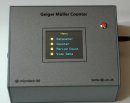 The Geiger Muller Counter is our second touch screen product. Our Geiger Tube connects directly to the Counter. No external high voltage is required, therefore the unit can be portable enabling experiments to be done away from the classroom. Readings can be stored and transmitted to Excel on a PC. A manual is available in the Teachers Section. The Geiger Muller Counter is our second touch screen product. Our Geiger Tube connects directly to the Counter. No external high voltage is required, therefore the unit can be portable enabling experiments to be done away from the classroom. Readings can be stored and transmitted to Excel on a PC. A manual is available in the Teachers Section. |
| |
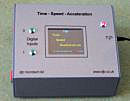 Time-Speed-Acceleration is a very flexible piece of kit which finds many applications in school Physics. With its touch screen and easy to use menus the setting up of the instrument is very straight forward. Excellent for studying momentum, projectiles, speed of sound... A manual is available in the Teachers Section. Time-Speed-Acceleration is a very flexible piece of kit which finds many applications in school Physics. With its touch screen and easy to use menus the setting up of the instrument is very straight forward. Excellent for studying momentum, projectiles, speed of sound... A manual is available in the Teachers Section. |
| |
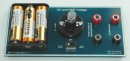 The RMS and DC Voltage board lets the user compare the brightness of a lamp when operating from AC & DC. The AC is adjusted until the brightness is the same for both supplies. At this point the energy being delivered to the lamp by both supplies is the same. A scope is then used to compare the peak AC and the DC voltages. The RMS and DC Voltage board lets the user compare the brightness of a lamp when operating from AC & DC. The AC is adjusted until the brightness is the same for both supplies. At this point the energy being delivered to the lamp by both supplies is the same. A scope is then used to compare the peak AC and the DC voltages. |
| |
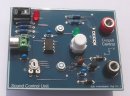 This unit was designed to show an interesting way of operating our Relay board. This unit was designed to show an interesting way of operating our Relay board.
You can control lamps and motors with the snap of your fingers OR replace the microphone with a phototransistor then control the lamp or motor with your TV remote.
Click for more info.
|
| |
| |
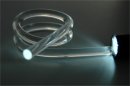 The Spiral Light Guide has been designed to show internal reflection and refraction. The Spiral Light Guide has been designed to show internal reflection and refraction.
Click for more info.
|
| |
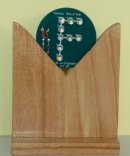 This bright source consisting of 9 LEDS lets basic optic work be done in the daylight. Clearly shows the image invertion in the vertical and horizonal planes. No more working with candles or carbon filament lamps. This bright source consisting of 9 LEDS lets basic optic work be done in the daylight. Clearly shows the image invertion in the vertical and horizonal planes. No more working with candles or carbon filament lamps.
Click to view more images and further information.
|
| |
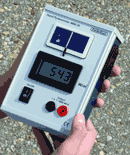 This instrument is designed for field measurements of global solar irradiance. The Pyranometer is supplied with a digital display for direct readout of the irradiance in watts per square meter. Two 4 mm sockets are provided so that the signal can, if required, be used by a datalogger. This instrument is designed for field measurements of global solar irradiance. The Pyranometer is supplied with a digital display for direct readout of the irradiance in watts per square meter. Two 4 mm sockets are provided so that the signal can, if required, be used by a datalogger. |
| |
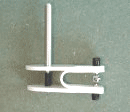 Falling Ball Release Mechanism Falling Ball Release Mechanism
Used in conjunction with our Timing Plate makes the 'g by free fall' experiment very easy to set up. |
| |
| |
| |
| |
| |
| |
| |
| |
| |
| |
| |
| |
|
|
